As businesses continue to modernize, advanced technologies are reshaping every aspect of operations, from customer support to financial management. Intelligent cloud platforms are enabling call center AI solutions to scale seamlessly, giving companies the flexibility to deploy artificial intelligence voicebots across multiple channels while maintaining secure, reliable infrastructure. Meanwhile, the rise of next-generation computing systems is enhancing how agents interact with customers, offering faster data processing and smarter decision-making that directly improves service efficiency.
On the marketing front, AI-driven promotional strategies are allowing companies to deliver hyper-personalized campaigns, optimize customer journeys, and analyze engagement in real time. Similarly, smart marketing automation tools leverage predictive analytics to identify trends, improve lead conversion, and support targeted outreach without manual intervention. In the financial sector, cognitive finance technologies are transforming call centers by enabling real-time fraud detection, automated transaction support, and predictive insights that empower agents to resolve customer inquiries faster and more accurately.
Together, these innovations illustrate why the case for AI in business call centers is so compelling: integrated AI solutions enhance operational efficiency, improve customer experiences, and redefine the way companies deliver support.
What Are Call Center AI Solutions?
Call center AI solutionsare technologies that use artificial intelligence and machine learning to automate, assist, and optimize customer interactions across voice and digital channels. They do not replace humans; theyaugmentthem, handling routine work so your teams can focus on complex, high-value conversations.
These solutions typically sit on top of or alongside your existing telephony, CRM, and ticketing systems. They interpret customer intent, route contacts intelligently, surface the right information to agents, and continuously learn from every interaction to improve over time.
Top Call Center AI Solutions to Transform Your Business
When it comes to implementing AI in business call centers, choosing the right solution can make all the difference. Here’s a list of leading platforms that help companies deliver smarter, faster, and more personalized customer support:
- Bright Pattern –
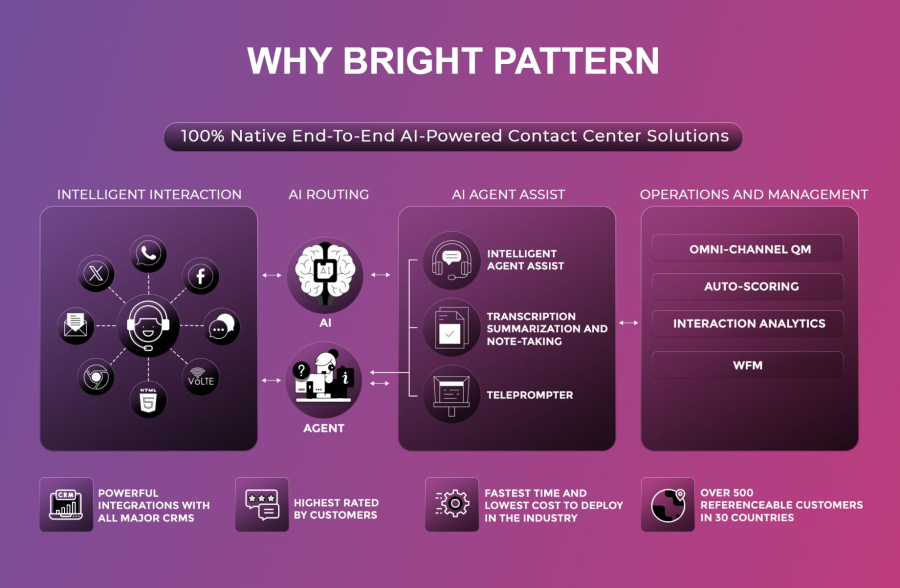
Bright Pattern is a cloud-native call center platform offering robust AI-powered features, including intelligent call routing, omnichannel support, and artificial intelligence voicebots. Its advanced analytics and automation tools help businesses reduce wait times, increase agent productivity, and deliver consistent, high-quality customer experiences. Bright Pattern’s scalable architecture ensures that companies of any size can deploy AI seamlessly, making it one of the most versatile solutions in the market.
- Five9 – Known for its AI-driven contact center platform, Five9 provides predictive dialing, chatbots, and workflow automation to improve agent efficiency and customer satisfaction.
- Genesys – Genesys offers omnichannel AI solutions with machine learning-driven routing, voicebots, and real-time analytics for enhanced customer engagement.
- NICE inContact – This platform combines AI-powered automation with cloud-based call center technology to optimize both inbound and outbound interactions.
- Talkdesk – Talkdesk leverages AI to enhance agent performance and provide predictive insights, helping businesses deliver faster, more personalized customer support.
- Zendesk – With AI-enabled chatbots and automated workflows, Zendesk improves service efficiency and enhances customer experiences across multiple channels.
- Avaya OneCloud – Avaya offers AI-assisted call handling, voicebots, and real-time analytics, focusing on seamless integration with existing business systems.
- RingCentral Contact Center – This platform uses AI to streamline communications, improve call routing, and provide actionable insights for agents and managers.
- Cisco Contact Center – Cisco combines AI, machine learning, and omnichannel routing to optimize call center operations and enhance customer satisfaction.
Components of Modern Call Center AI
While every vendor bundles features differently, most modern call center AI solutions include several core capabilities.
1. Conversational IVR and Virtual Agents
Traditional IVR menus force customers to “press 1, press 2” through long phone trees.Conversational IVRandAI virtual agentsreplace this with natural language interactions. Customers can simply say what they need, and AI determines the intent and either resolves the request or routes it appropriately.
- 24/7 automated self-service for routine questions
- Natural language understanding instead of rigid menu trees
- Consistent responses aligned with your business rules and knowledge base
2. Intelligent Routing and Triage
AI routinggoes beyond skills-based routing and static rules. It evaluates context such as:
- Customer intent and sentiment
- Customer value, history, and preferences
- Channel and language
- Agent skills, performance, and real-time availability
Then it decides where the contact should go for the best outcome, improving first contact resolution and customer satisfaction while balancing workloads across teams.
3. Real-Time Agent Assist
Agent assisttools augment human agents during live calls and chats. AI listens, reads, and understands the interaction, then:
- Suggests next best actions and responses
- Surfaces relevant knowledge articles and policies
- Flags compliance risks or missing disclosures
- Auto-fills after-call summaries and dispositions
This reduces handle time, improves accuracy, and supports new agents who are still learning.
4. AI-Powered Knowledge Management
AI-driven knowledge systems help both customers and agents quickly find the right answer. Instead of manually hunting through static FAQs, AI:
- Searches across documents, past tickets, and product content
- Understands natural language questions
- Ranks and presents the most relevant answer snippets
- Continuously learns from resolved interactions to improve content
5. Analytics, Quality, and Coaching Intelligence
Call center AI solutions also transform how leaders monitor and improve performance. Speech analytics, sentiment analysis, and automation enable:
- Automatic analysis of 100% of calls and digital interactions
- Objective quality scoring and detection of coaching opportunities
- Insights into trending issues, root causes, and emerging risks
- Forecasting and capacity planning based on real patterns
Key Business Benefits of Call Center AI Solutions
The business case for call center AI is strong when it is deployed thoughtfully. Here are the most important benefits organizations typically aim for.
1. Faster Response Times and Lower Wait Times
AI handles routine interactions instantly, without placing customers in a queue. It can also triage and pre-collect information before they ever reach an agent. The result is:
- Shorter average speed of answer
- Reduced abandonment rates
- Less time customers spend repeating information
2. Higher First Contact Resolution
When AI understands intent accurately and routes contacts based on context, customers are more likely to reach the right person or self-service flow the first time. Agent assist further supports agents with the information they need to resolve issues on the spot.
3. Lower Operating Costs Without Sacrificing Quality
By deflecting repetitive calls and chats to self-service, AI reduces the overall interaction volume reaching your agents. This enables you to:
- Handle growth without linearly expanding headcount
- Reallocate agents from low-value to high-value work
- Extend service hours without proportional staffing costs
Importantly, this cost efficiency comes with improved consistency and quality, not at its expense.
4. Better Customer Experience and Brand Perception
Customers increasingly expect fast, personalized, frictionless support. Call center AI helps you deliver:
- Always-on support, even outside business hours
- Personalized interactions informed by history and preferences
- Reduced transfers and fewer requests to repeat details
- Consistent answers across channels and agents
5. Happier, More Empowered Agents
A powerful but sometimes overlooked benefit is the impact on your people. When AI absorbs repetitive tasks and provides in-the-moment guidance, agents experience:
- Less cognitive load and stress
- Shorter onboarding and time to proficiency
- More meaningful conversations with customers
- Clearer coaching feedback based on objective data
This often translates to higher engagement and lower turnover, which further strengthens your service quality over time.
Traditional vs AI-Enhanced Call Centers
The table below highlights how operations typically change when AI solutions are introduced.
Dimension | Traditional Call Center | AI-Enhanced Call Center |
Customer access | Limited hours, phone-heavy, queue-based | 24/7 automated support, seamless across channels |
Routing | Basic skills or manual transfer | Intent, sentiment, and value-based routing |
Agent support | Manual search, memory, supervisor help | Real-time recommendations, knowledge surfacing |
Quality monitoring | Sampled interactions, manual review | Automatic analysis of nearly all interactions |
Scalability | Linear with headcount | Scales with demand via automation |
Top Use Cases for Call Center AI Solutions
AI can support nearly every interaction type, but some use cases consistently deliver fast, visible wins.
1. Self-Service for Common Requests
Virtual agents and conversational IVR excel at handling high-volume, low-complexity requests, such as:
- Checking order, delivery, or claim status
- Resetting passwords or unlocking accounts
- Updating contact or payment details
- Providing basic product or policy information
By automating these interactions, you free agents to focus on emotionally sensitive or complex situations where human judgment matters most.
2. Intelligent Triage for Complex Issues
Even when AI cannot fully resolve an issue, it can still collect details, authenticate the customer, and classify the request before handing off to an agent. This reduces average handle time and minimizes back-and-forth questioning.
3. Real-Time Compliance and Risk Monitoring
In regulated industries, AI can monitor interactions in real time and post-call to:
- Detect missing mandatory disclosures
- Flag potential regulatory or policy breaches
- Identify vulnerable customers and escalate as needed
This improves compliance coverage and supports coaching, without relying solely on manual sampling.
4. Sales and Cross-Sell Support
AI can recognize buying signals and suggest relevant offers during service calls or chats. With context-aware prompts and product recommendations, agents can:
- Identify upsell and cross-sell opportunities more consistently
- Personalize offers based on customer history and needs
- Follow approved sales scripts and objection-handling guidelines
5. Workforce Management Optimization
By analyzing historical and real-time interaction data, AI supports more accurate forecasting and scheduling. This leads to:
- Better alignment of staffing with demand peaks and valleys
- Reduced overtime and under-utilization
- Improved service levels with the same or fewer resources
How AI Transforms the Agent Experience
Successful call center AI solutions are designed with agents at the center. When implemented well, they make a typical day noticeably better for your team.
Before the Interaction
- Pre-call context.AI surfaces relevant customer details, recent interactions, and predicted intent as soon as the contact arrives.
- Smart routing.Agents receive interactions that match their expertise, language, and capacity, improving confidence and flow.
During the Interaction
- Guided conversations.Agent assist tools recommend talking points, next steps, and compliant phrases.
- Instant answers.AI-powered search brings up the right procedures and knowledge snippets in seconds.
- Sentiment indicators.Real-time sentiment cues help agents adjust tone and approach to de-escalate tension.
After the Interaction
- Automated wrap-up.AI drafts call notes, dispositions, and tags, allowing agents to confirm rather than type from scratch.
- Actionable feedback.Objective insights on call quality, script adherence, and soft skills support targeted coaching and career growth.
Implementation Roadmap: From Pilot to Full Rollout
A structured approach helps you capture the full value of call center AI while minimizing risk.
1. Define Objectives and Success Metrics
Begin with clear goals that connect directly to your customer experience and operational priorities, such as:
- Reducing average handle time by a defined percentage
- Deflecting a portion of calls to self-service
- Improving customer satisfaction scores for specific journeys
- Shortening agent onboarding time
Agree on how you will measure success and over what timeframes.
2. Map Customer Journeys and Identify High-Impact Use Cases
Next, examine your customer journeys and contact drivers. Look for:
- High-volume, low-complexity interactions suitable for automation
- Journeys where routing or handoffs frequently break down
- Processes with clear compliance steps that can be guided or monitored by AI
Select a small number of use cases for an initial pilot that can show tangible results quickly.
3. Prepare Your Data and Knowledge Assets
AI outcomes depend heavily on the quality of the data and knowledge feeding it. Work with stakeholders to:
- Consolidate and clean key knowledge articles and FAQs
- Standardize terminology and remove outdated content
- Integrate relevant CRM, ticketing, and product data sources
- Define guardrails for what the AI can and cannot say or do
4. Design and Launch a Controlled Pilot
For your pilot:
- Start with a defined segment of calls, channels, or customer groups
- Involve a representative set of agents and supervisors
- Monitor performance daily and capture qualitative feedback
- Iterate quickly on conversation flows, knowledge, and routing rules
5. Scale Gradually and Continuously Improve
Once you have validated the benefits and refined the experience, expand to additional use cases and customer segments. Maintain a continuous improvement loop that includes:
- Regularly reviewing analytics and quality insights
- Updating knowledge articles and training data
- Refreshing scripts and intents based on new products and policies
Build vs Buy: Choosing the Right Call Center AI Platform
Organizations often face a choice between building custom AI capabilities and buying a commercial solution. Each approach has strengths.
When Buying Makes Sense
- You want faster time to value and proven best practices built in.
- You have limited internal AI engineering resources.
- You need robust integrations with telephony, CRM, and workforce tools.
- You value vendor support, roadmaps, and compliance certifications.
When Building or Extending Internally Makes Sense
- You have strong in-house AI and software engineering teams.
- You require highly specialized domain models or workflows.
- You want granular control over every aspect of the AI stack.
Many organizations adopt a hybrid strategy: buying a core platform while building custom integrations, models, or experiences on top to fit unique business needs.
Metrics to Track for AI-Powered Call Centers
Measuring the right metrics ensures you can prove value, optimize performance, and guide further investment. Consider tracking:
- Automation rate.Percentage of interactions fully resolved by AI without human intervention.
- Containment rate.Portion of customers who begin and end within self-service, without escalation.
- Average handle time.Changes for both automated and human-assisted interactions.
- Customer satisfaction and sentiment.Scores and sentiment trends before and after AI rollout.
- First contact resolution.How often issues are fully resolved in a single interaction.
- Agent productivity.Interactions handled, wrap-up time, and time to proficiency.
- Quality and compliance scores.Coverage and adherence improvements.
Common Myths and How to Address Them
Despite strong results across industries, several myths can slow down adoption of call center AI solutions. Proactive communication helps overcome these concerns.
“AI Will Replace Our Agents”
In practice, most organizations use AI toaugmenthumans, not replace them. As automation takes over repetitive tasks, agents shift toward complex, relationship-driven, and revenue-generating conversations. Highlight how AI reduces stress and enhances skills rather than threatening jobs.
“Customers Do Not Like Talking to Bots”
Customers dislikebadautomation. When virtual agents are well-designed, transparent, and offer quick resolutions, many customers prefer them for simple tasks. Ensure that customers always have an easy path to reach a human when needed to build trust.
“AI Is Too Complex for Our Organization”
Modern platforms are designed to be accessible to business and operations teams, not just data scientists. You can start small with targeted use cases, using configuration and natural language tools rather than heavy custom coding. Training, vendor support, and clear governance further reduce complexity.
Future Trends in Call Center AI
Call center AI is evolving rapidly. Keeping an eye on emerging trends helps you make investments that will stand the test of time.
1. More Human-Like, Context-Aware Conversations
Advances in language models are making virtual agents more natural, empathetic, and context-aware. They are increasingly able to handle multi-turn conversations, recall previous interactions, and adapt to customer preferences.
2. Unified Experiences Across Channels
Customers expect to move seamlessly between voice, chat, messaging, and email without losing context. AI will play a central role in orchestrating and personalizing these journeys across channels, so customers feel recognized and supported wherever they are.
3. Deeper Integration with Back-Office Systems
The next wave of value comes from connecting AI not only to front-office systems but also to back-office processes. This enables end-to-end automation of tasks such as refunds, appointment scheduling, or document processing, further reducing effort for both customers and agents.
4. Stronger Governance, Security, and Transparency
As AI becomes more powerful, organizations are investing in robust governance frameworks. Expect clearer policies on data usage, model oversight, bias monitoring, and explainability, all designed to keep AI responsible, secure, and aligned with customer trust.
Preparing Your Organization for Call Center AI
Technology is only part of the journey. To unlock the full benefits of call center AI solutions, focus on three enablers: people, process, and culture.
1. Engage Agents and Supervisors Early
Agents and frontline leaders are critical partners. Involve them in designing use cases, testing flows, and providing feedback. Emphasize how AI will support them, not monitor them unfairly, and celebrate quick wins that make their workday better.
2. Update Processes for an AI-Augmented Environment
Review your existing procedures and performance policies. Make sure they align with new roles and responsibilities when AI is in the mix. Examples include:
- Defining clear handoff rules between virtual agents and humans
- Adjusting quality scorecards to include AI-assisted behaviors
- Refreshing training materials to cover AI tools and best practices
3. Build a Culture of Experimentation and Continuous Improvement
AI thrives in environments where teams are comfortable testing, learning, and iterating. Encourage small experiments, rapid feedback cycles, and collaborative problem-solving across operations, IT, and analytics. Position every improvement as a step toward a better customer and agent experience.
Conclusion: Turning AI into a Strategic Advantage
Call center AI solutions are no longer experimental; they are becoming a core part of modern customer service strategies. When thoughtfully implemented, they deliver faster responses, more consistent quality, lower costs, and a more engaging work environment for agents.
You do not have to transform everything at once. By starting with clear goals, high-impact use cases, and a strong focus on both customers and agents, you can build an AI-augmented contact center that scales with your business and sets your brand apart.
